

Transcription
termination control in Gram-positive bacteria;
RNA structure/function, RNA sensors.
The
main area of interest in our laboratory
is the analysis of the mechanisms through
which cells sense changes in their environment
and transmit that information to the level
of gene expression. We use the Gram-positive
bacterium Bacillus subtilis as
a model system, and we focus on genes involved
in protein synthesis and amino acid metabolism.
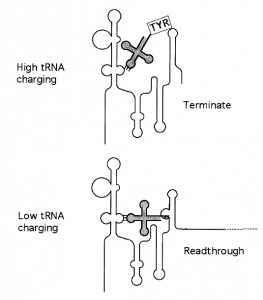
Transcription antitermination -
nascent RNAs can sense uncharged tRNA:
Characterization
of the B. subtilis tyrS gene, encoding
tyrosyl-tRNA synthetase, revealed a novel
mechanism of gene regulation at the level
of transcription antitermination. The tyrS
gene is a member of a large family
of aminoacyl-tRNA synthetase and amino acid
biosynthesis genes in Gram-positive bacteria
that are regulated by a common mechanism.
Each gene in this family responds individually
to limitation for the appropriate amino
acid. Amino acid limitation is monitored
via interaction of the mRNA leader region
of the gene with the cognate uncharged tRNA.
This interaction is directed by pairing
of the anticodon of the tRNA with a single
codon, designated the "specifier sequence,"
in the mRNA leader. We have now demonstrateed
that the mRNA-tRNA interaction occurs in
the absence of translation, and that antitermination
can occur in a purified transcription system
with no additional cellular factors, indicating
that the leader RNA is sufficient for specific
recognition of the cognate tRNA. We are
currently investigating the molecular details
of the leader RNA-tRNA interaction, and
the structural shifts in both RNA partners
that occur upon binding.
Transcription
antitermination - nascent RNAs can sense
small molecules:
Analysis
of genes involved in methionine metabolism
revealed a second global transcription antitermination
system, dedicated to genes in this pathway.
Like the T box system, the S box system
is also widely used in Gram-positive organisms.
Genes regulated by this mechanism contain
highly conserved sequence and structural
elements in their mRNA leader regions, and
expression is induced by starvation for
methionine. We have now shown that the molecular
effector for this system is S -adenosylmethionine,
which binds directly to the leader RNA and
modululates its structure to promote transcription
termination. We have also shown that lysine
biosynthesis genes are regulated by a similar
mechanism, with specific leader RNA binding
of lysine. Current work is focusing on the
molecular mechanisms of effector recognition
and RNA rearrangement in response to effector
binding.
|

Henkin,
T. M.
and C. Yanofsky. 2002. Regulation by transcription
attenuation in bacteria: How RNA provides
instructions for transcription termination/antitermination
decisions. BioEssays 24:
700-707.
Grundy,
F. J., W. C. Winkler and T. M. Henkin.
2002. tRNA-mediated transcription antitermination
in vitro: Codon-anticodon pairing independent
of the ribosome. Proc. Natl. Acad. Sci.
USA 99:
11121-11126.
Gerdeman,
M. S., T. M. Henkin and
J. V. Hines. 2003. Solution structure of
the B. subtilis T box antiterminator
RNA: Seven-nucleotide bulge characterized
by stacking and flexibility. J. Mol. Biol.
326:
189-201.
McDaniel,
B. A. M., F. J. Grundy, I. Artsimovitch
and T. M. Henkin. 2003.
Transcription termination control of the
S box system: direct measurement of S
-adenosylmethionine by the leader RNA.
Proc. Natl. Acad. Sci. USA. 100:
3083-3088.
Yousef,
M. R., F. J. Grundy and T. M. Henkin.
2003. tRNA requirements for glyQS antitermination:
A new twist on tRNA. RNA 9:
1148-1156.
Grundy,
F. J., S. C. Lehman and T. M. Henkin.
2003. The L box regulon: Lysine sensing
by leader RNAs of bacterial lysine biosynthesis
genes. Proc. Natl. Acad. Sci. USA 100:
12057-12062.
Grundy,
F. J. and T.
M. Henkin. 2004. Regulation
of gene expression by effectors that bind
to RNA. Curr. Opin. Microbiol. 7:
126-131.
Ito, M., Hicks, D.B.,
Henkin, T.M., Guffanti,
A.A., Powers, B., Zvi, L., Uematsu, K. and
Krulwich, T.A. 2004. MotPS is the stator-force
generator for motility of alkaliphilic Bacillus
and its homologue is a second functional
Mot in Bacillus subtilis . Mol. Microbiol.
53:1035-1049.
Grundy,
F. J. and T.
M. Henkin. 2004. Kinetic
analysis of tRNA-directed transcription
antitermination of the Bacillus subtilis
glyQS gene in vitro. J. Bacteriol.
186:
5392-5399.
Grundy, F. J., M. R. Yousef and T.
M. Henkin. 2005.
Monitoring uncharged tRNA during transcription
of the Bacillus subtilis glyQS
gene. J. Mol. Biol. 346: 73-81.
Yousef, M. R., F. J. Grundy and T.
M. Henkin. 2005.
Structural transitions induced by the interaction
between tRNAGly and the Bacillus subtilis
glyQS T box leader RNA. J. Mol. Biol.
349:273-287.
McDaniel, B. A., F. J. Grundy and T.
M. Henkin. 2005.
A tertiary structural element in S box leader
RNAs is required for SAM-directed transcription
termination. Mol. Microbiol. 57:1008-1021.
Fuchs,
R.T., Grundy, F.J. and Henkin,
T. M. 2006. The SMK
box is a new SAM binding RNA element that
regulates translation of bacterial SAM synthetase
genes. Nature Struct. Mol. Biol. 13:226-233.
Gardner,
J.G., Grundy, F.J., Henkin,
T. M. and Escalante-Semerena,
J.C. 2006. Control of acetyl-CoA synthetase
(AcsA) activity by acetylation/deacetylation
without NAD+ involvement in Bacillus subtilis.
J. Bacteriol. 188:5460-5468.
Grundy,
F.J. and Henkin,
T. M. 2006. From
ribosome to riboswitch: control of gene
expression in bacteria by RNA structural
rearrangements. Crit. Rev. Biochem. Mol.
Biol. 41:329-338.
McDaniel, B.A.M., Grundy, F.J., Kurlekar,
V., Tomsic, J. and Henkin,
T. M. 2006. Identification
of a mutation in the Bacillus subtilis
SAM synthetase gene that results in derepression
of S box gene expression. J. Bacteriol. 188:3674-3681.
Nelson, A., Henkin,
T. M. and Agris.
P.F. 2006. tRNA regulation of gene expression:
interaction of an mRNA 5’-UTR with
a regulatory tRNA. RNA 12:1254-1261.
Terahara,
N., Fujisawa, M., Powers, B., Henkin,
T. M., Krulwich,
T.A. and Ito, M. 2006. An intergenic stem-loop
mutation in the Bacillus subtilis
ccpA-motPS operon increases motPS transcription
and the MotPS contribution to motility.
J. Bacteriol. 188:2701-2705.
Young,
R., Henkin,
T. M. and Turnbough,
C.L., Jr. 2006. The Phage Meeting: classical
venue, new momentum. J. Bacteriol. 188:4597-4600.
Henkin, T. M. and F. J. Grundy. 2007. Sensing metabolic signals with nascent RNA transcripts: The T box and S box riboswitches as paradigms. Cold Spring Harbor Symp. Quant. Biol., Regulatory RNAs. 71:231-237.
Fuchs, R. T., F. J. Grundy and T. M. Henkin. 2007. S-adenosylmethionine directly inhibits binding of 30S ribosomal subunits to the SMK box riboswitch RNA. Proc. Natl. Acad. Sci. USA 104:4876-4880.
|